Why does CUBIC take us again to TCP congestion management?

TCP congestion management is a basic a part of this protocol and over time has undergone a strategy of fixed enchancment by means of the technology of various variations, comparable to TCP Tahoe, Reno, Vegas, and so forth.
The case of the TCP CUBIC model, which has been the default congestion management utilized by Linux/Unix programs.
TCP CUBIC turns into much more fascinating since Microsoft has determined that this model is a basic a part of merchandise comparable to Home windows 10 and Home windows Server 2019, as learn on this doc on the information of Home windows Server 2019 and on this on Home windows 10.
Having the identical distribution in Linux and Home windows environments has led community directors to overview the concept behind the congestion management posed by TCP and what TCP CUBIC implies.
Let’s begin by reviewing the basic concept of TCP congestion management.



Window administration as a foundation for congestion management
TCP introduces the idea of “home windows” to determine site visitors stream management and handle connections between two gadgets: a sender and a receiver.
Thus, the fundamental implementation is called the obtain window, wherein, per connection, a window dimension is ready that represents the quantity of packets that the sender can ship to the receiver with out ready for recognition packets (ACK packets).
Nevertheless, the slider protocol manages the connection primarily based on the buffer capacities of the receiving gear, however it doesn’t acknowledge the congestion issues related to the community.
To regulate the transmission relying on the extent of congestion, TCP introduces one other window. That is the congestion window or cwnd to manage the variety of packets despatched primarily based on TCP’s notion of the congestion.
However how does TCP understand congestion on the community and what does it do accordingly?
The essential concept is as follows:
- If there are misplaced packets, it’s assumed that there’s congestion on the community, and packet loss is evaluated on the idea of obtained and never obtained acknowledgement packets.
- If congestion is set to exist, the congestion window is modified in such a manner that the sender slows down the sending of its packages.
- If no congestion is set, the congestion window shall be modified in order that the sender can ship extra packets.
On this primary process we discover a number of algorithms that implement it.
Algorithms suggest issues like what number of not obtained ACK packets contain congestion, how a lot to lower or enhance the cwnd window, find out how to calculate the switch fee from the congestion window, and so on.
Then we propose you to overview the evolution of those algorithms to be able to have a transparent understanding of the scope of these at present in use.
Evolution of congestion management algorithms
The evolution of TCP congestion management started within the mid-Eighties.
As much as that time, streaming management primarily based on sliding home windows had labored fairly properly, however with the popularization of the Web, congestion turned an issue.
Between 1986 and 1988, Van Jacobson proposed the fundamental congestion management scheme and developed the primary implementation protocol, often called TCP Tahoe.
The transmission ratio ought to have in mind the worth of the reception and congestion home windows, leaving the transmitter restricted to a transmission ratio whose minimal worth is rwnd and its most is cwnd.
In 1990 with TCP Reno the appliance of the AIMD algorithm (additive enhance / multiplicative lower) was launched:
- The transmission fee will steadily enhance till some packet loss happens.
- The rise shall be made by linearly rising the congestion window, i.e. by including a worth.
- If congestion is inferred, the transmission ratio shall be decreased, however on this case a lower shall be made by multiplying by a worth.
After TCP Reno different algorithms and variations of TCP appeared that attempted to take the precepts of congestion management and refine it, experiencing an ideal diversification of variations and scopes.
Thus we have now that TCP Vegas raises consideration to the values of delay to deduce congestion or the case of ECN (Express Congestion Notification) that introduces the chance that the routers of the community notify congestion situations to the transmitting gear.
It has additionally promoted the event of an excellent variety of mechanisms that enable the implementation of AIMD, comparable to Gradual Begin, Quick Retransmission, Quick restoration, Adaptive timeout or ACK clocking.
In any case, it’s fascinating to make clear the scenario we had till just lately.
The Linux world had opted for TCP CUBIC, which is an inheritor to TCP Reno and BIC TCP, so it depends on packet loss fairly than on delay values to find out congestion.
Whereas the Home windows world used an algorithm referred to as TCP Compound, which comes from TCP Quick, which in flip is inheritor to TCP Vegas, so that they depend on delays to deduce congestion.
As we talked about in the beginning of this text, this case modified when Microsoft determined to introduce TCP CUBIC in its new merchandise.
TCP CUBIC
TCP CUBIC is a congestion management algorithm that arises with the concept of benefiting from the truth that at present’s communications hyperlinks are inclined to have more and more greater bandwidth ranges.
In a community composed of huge bandwidth hyperlinks, a congestion management algorithm that slowly will increase the transmission fee might find yourself losing the capability of the hyperlinks.
The intention is to have an algorithm that works with congestion home windows whose incremental processes are extra aggressive, however are restricted from overloading the community.
With the intention to obtain this, it’s proposed that the scheme for rising and lowering the transmission ratio be established based on a cubic operate. Let’s see the subsequent determine:
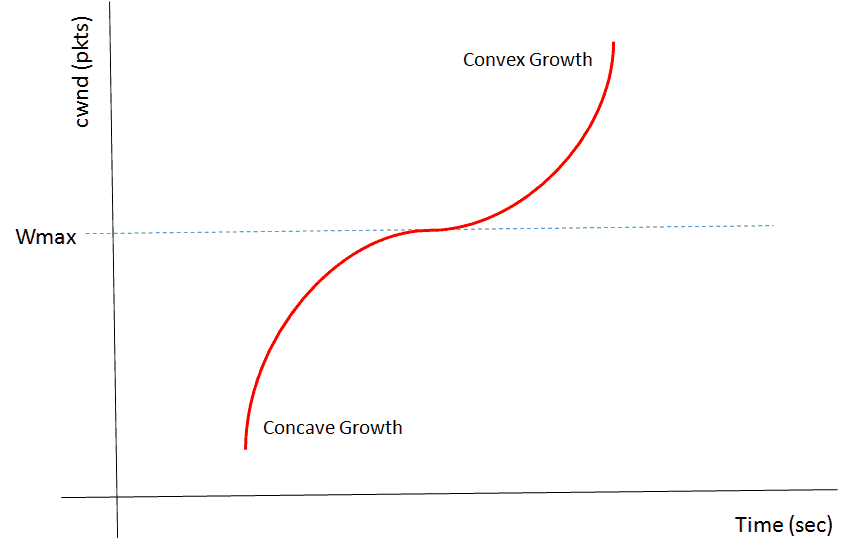
Description: Cubic operate that regulates the congestion window based on the Cubic algorithm
From: IEEE Xplore Digital Library: https://ieeexplore.ieee.org/doc/8368259
The process adopted by the algorithm is:
- On the time of experiencing congestion occasion the window dimension for that prompt shall be recorded as Wmax or the utmost window dimension.
- The Wmax worth shall be set because the inflection level of the cubic operate that can govern the expansion of the congestion window.
- The transmission will then be restarted with a smaller window worth and, if no congestion is skilled, this worth will enhance based on the concave portion of the cubic operate.
- Because the window approaches Wmax the increments will decelerate.
- As soon as the tipping level has been reached, i.e. Wmax, the worth of the window will proceed to extend discreetly.
- Lastly, if the community continues to be not experiencing any congestion, the window dimension will proceed to extend based on the convex portion of the operate.
As we will see, CUBIC implements schemes of huge increments at first, which lower across the window dimension that precipitated the final congestion, after which proceed to extend with giant increments.
If you wish to be taught extra in regards to the technical particulars of the CUBIC algorithm, you’ll be able to learn the next work:
https://www.cs.princeton.edu/programs/archive/fall16/cos561/papers/Cubic08.pdf
Congestion management and monitoring instruments
An fascinating level of congestion management offered by TCP is that these are processes with the next traits:
- These processes run solely within the emitting gear.
- They don’t generate site visitors.
- They promote an equitable distribution of the transmission capability of the community. As every gadget decides on its transmission capability, considering solely the behaviour of the community it observes, no emitting gadget is favoured or harmed below any circumstances.
Nevertheless, it’s simple to grasp that it isn’t honest to match the capabilities of TCP’s congestion management algorithms with the capabilities of a monitoring device, as a result of we’re shifting in two fully totally different universes.
Nevertheless, we suggest you to consider the scope of a basic objective monitoring device like Pandora FMS from the angle of those algorithms.
These are the next factors:
- The item of research of a monitoring device is far broader: a monitoring device should take into account all of the protocols current on the platform, not simply TCP.
- The thought of a monitoring device is to incorporate below its scheme all of the elements, all the time providing a world imaginative and prescient of the platform.
- The mechanisms utilized by a monitoring device, comparable to these related to community administration comparable to SNMP or with site visitors stream management comparable to NetFlow, are protocols that contain sending packets related to their features. Now, after all, the monitoring instruments intention to determine a scheme that interferes simply sufficient with the general efficiency of the platform.
- The foundation reason behind congestion: The strategy achieved by the monitoring instruments goals to get to the basis reason behind congestion. Maybe the reason for a state of congestion is within the flawed configuration of a routing protocol, which isn’t going to be corrected by the emitting gear modifying its transmission capability.
- To conclude, we should say that one goal of the monitoring instruments is to generate info that permits predicting a congestion scenario earlier than it seems.
Take a look at this fascinating article on bandwidth monitoring.
As well as, if you don’t but have a monitoring device for the platform, you must know that you’ve got come to the fitting place. The truth is, if in case you have greater than 100 gadgets we propose you consider Pandora FMS Enterprise.
And if in case you have a decreased variety of gadgets we advocate you to obtain the Pandora FMS Open Supply model.